
Neosurf's story remains elusive despite real effort to capture it. The solution might lie in rethinking what a payment method can be.
View the Substack edition and join the email list for future posts.
Neosurf’s story remains elusive despite real effort to capture it. The solution might lie in rethinking what a payment method can be.
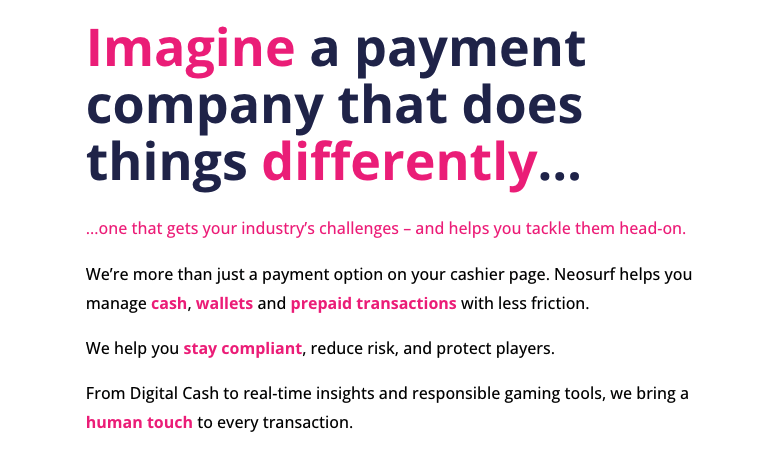
I first spotted them at SiGMA Rome, the last booth at the end of the third day. They stood out, and not just because of the pink. They made a real attempt to capture who they are:
“A digital wallet provider that turns cash into data to support your safer gambling strategy.”
Light-years ahead of 90% of the industry. Others don’t even try to capture so clearly who they are, what they do, how they solve a problem, and for whom.
At ICE last week, I stopped by again to commend them for standing out. But something had changed. The message now read:
“Our digital wallets turn cash into your competitive advantage”
and also
“Creators of the first operator-friendly wallet built for responsible gaming.”
Three different messages. Two different events.
Neosurf is trying harder than most to articulate their value. But the inconsistency signals they haven’t found the positioning that captures what they actually do.
Like Bettorify splitting energy between two narratives, Neosurf’s story divides attention between “responsible gaming” and “digital wallet”. And like Bazoom, without clearly translating their differentiators, they leave a cognitive gap for operators to fill themselves.
That made me curious, so I decided to dive in.
Neosurf is a voucher-based, cash-to-digital payment provider available in 150,000+ retail points globally. Players gravitate to it for its cash-like qualities: privacy and control.
The Privacy-Conscious Players
These players don’t want to hand over private information to every pop-up casino. They also don’t want gambling transactions on their bank statements, traces that could impact their credit score, mortgage applications, or expose them to judging eyes. They want no link between their primary financial identity and their betting activity.
The Controlled Spenders
Other players choose it because of the control it grants them.
The high-friction buying process – physically going to a retail location, exchanging cash for a 10-digit PIN, then using that voucher to deposit at an operator – creates natural barriers against impulsive, binge betting. These players love betting, but they want the budget spending control to protect them from going off the rails. The voucher system has built-in limits. You can only spend what you’ve pre-loaded. The pre-payment structure gives them control over their entertainment budget.
Careful Wagers
These two audiences – the privacy-conscious and the controlled spenders – may be slightly different, but in this case we can reframe them as one, like in Blask’s case. Combined, they are the careful wagers.
Being careful doesn’t make them cheap or low-value. These players want privacy and control, not limits on their entertainment budget.
This isn’t a fringe segment. Approximately 35% of frequent bettors actively seek to decouple leisure spending from banking records to protect creditworthiness and mortgage eligibility. Over 50% demand integrated budgeting tools. A third already budget gambling into monthly expenses. The segment is real, growing, and underserved.
Being careful doesn’t make them cheap or low-value. These players want privacy and control, not limits on their entertainment budget. The segment is real, growing, and underserved.
Anonymous players pose a regulatory risk. Operators must verify identity to prevent money laundering, underage gambling, and fraud. But verification creates friction that drives privacy-conscious players away.
In certain jurisdictions, they’re not allowed at all. In others, low-sum betting without KYC is permitted up to a threshold, often around €250 in markets like Canada, Australia, and parts of Europe. But once the player crosses that limit (typically €2,000 cumulative) or requests a payout, KYC becomes mandatory.
Without a solution, operators face a tough choice: deny these players entirely, or accept them and take on regulatory risk.
The solution is a Compliance Handshake. An API integration that shares KYC data, tracks velocity across 20,000+ merchants, and provides affordability signals (through partnerships like Department of Trust in the UK, which verifies players’ discretionary income via Open Banking without operators ever seeing their bank statements).
Players start with low-friction deposits up to regulatory thresholds (typically €250 in markets like Canada and Australia). When they cross the limit or request a payout, they verify once with Neosurf, which passes pre-verified data to operators. Players maintain their sense of privacy, operators get faster onboarding, and compliance is maintained.
Retention Through Risk Management
Operators can go further to leverage this edge. When a player shows affordability risk or binge-betting patterns, operators can direct them to Neosurf-only deposits. This allows operators to benefit from its built-in friction, affordability checks, and spending limits, reducing compliance risk while retaining the player in their ecosystem. Without this option, operators might have to exclude these players entirely. With it, they can keep them playing safely.
The company is trying to communicate its value. But neither message lands.
Calling themselves a ‘digital wallet provider’ doesn’t communicate operator value. It describes what the product is (players can consolidate multiple vouchers into one balance and receive payouts back to their account), not what operators get. This cognitive gap forces operators to connect dots. Some will. Most won’t.
Positioning around “responsible gaming” is accurate but emotionally flat. Like in Finnplay’s case, compliance is insurance: necessary, but not exciting. Decision-makers don’t dream about preventing problems. They dream about opportunities.
APMs don’t have to be geographic or generational. They can be segmental or behavioral.
Operators understand the value of Alternative Payment Methods (APMs) and how they fit in their stack. Pix for Brazil. Specific methods for Gen Z. They know entering a market or demographic requires the right payment infrastructure.
But APMs don’t have to be geographic or generational. They can be segmental or behavioral.
The company already serves a segment: careful wagers who need privacy and control. That’s were the positioning and story opportunity lies. Not ‘digital wallet.’ Not ‘responsible gaming.’
The APM for careful wagers.
This reframing changes everything. Operators aren’t evaluating “another digital wallet.” They’re evaluating access to a player segment they couldn’t safely serve before.
(Other payment providers, by the way, can own other positioning opportunities. For example, who would be the APM for whale players?)
Neosurf is an alternative payment method for careful wagers that expands operators’ addressable market, lowers acquisition costs, and retains at-risk players.
Easy to understand, sparks curiosity, attracts the attention of operators, and easy to remember.
HaArba'a St 28, Tel Aviv-Yafo
© Copyright 2025 by Braintail