
Despite its competitive edge, the company's messaging doesn't move prospects to act
View the Substack edition and join the email list for future posts.
ISX is lost in translation.
Its financial stack offers top-tier iGaming operators certainty through depth. The company is deeply integrated into the global financial network, deeply integrated into its customers’ business, and deeply embedded in the transaction flow itself. Each layer delivers a level of financial and operational certainty that no other EMI in this space can match.
But ISX doesn’t translate that depth into messaging that moves prospects to act. And without that translation, they end up saying “you can trust us” like everyone else in the market. Without turning its advantage of depth into a strong brand narrative and positioning, ISX is left with generic messaging and risks losing its competitive edge.
Finance is first and foremost a trust-based industry. When looking for a financial partner, operators need someone who understands their business and has the foundation to support their growth. Not a faceless provider that can kill it overnight.
Last month, Geonode’s COO described in a public post how Wise closed their business and personal accounts. No warning. No prior discussion. No explanation beyond a short email. Cash flow froze, operations stopped, and no one picked up the phone. That’s the nightmare of every business: getting disconnected from your money with no path to resolution. It’s what operators fear most, it’s what every provider promises to prevent, and it’s nearly impossible to tell upfront how the relationship with a provider will play out.
Being perceived as too risky, or having your business mistaken for malicious activity, can lead to “de-risking”: a clean term for stopping service and disconnecting you from the global financial network.
To understand why de-risking is so dangerous, you need to understand the network it disconnects you from.
Have you ever wondered why there are so many banks and seemingly infinite payment providers? There are only two or three major airplane manufacturers, a handful of social networks, and a finite number of telecom companies. Network effects and economies of scale led to consolidation in those industries. So how come finance is different?
Money is contextual. A €500,000 transfer for a house is not the same as a €500,000 casino win or a €500,000 provider’s commission. Each transaction carries its own regulatory metadata and adheres to different rules.
Banking is regional, highly regulated, highly contextual. A bank in your town knows the local real estate market well enough to give you a mortgage. A bank on the other side of the world does not.
These regulatory, operational, and contextual constraints are why there are so many banks, financial institutions, and payment providers. Unlike airplane manufacturers, social networks, or telecom companies, there is no economy of scale that leads to consolidation.
As a result, we don’t have a handful of banks serving the world’s needs. We have an intricate web of interconnected banks, financial institutions, regulators, and businesses forming the global financial network. A financial internet, if you like.
This network consists of vaults and rails. Vaults are the bank accounts that store money. Rails are the pathways through which money flows between them. Every financial transaction is money moving from one vault to another along the network’s rails.
Like the internet, it has a core backbone and edges. On the internet, the closer you are to the backbone, the faster and more reliable your connection. At the edge, service is intermittent and weak.
The global financial network works the same way. The closer you are to the core, the faster, safer, and more trusted your transactions are. But proximity to the core comes at a heavy regulatory and operational price. Connected to the edge, you get slower, riskier financial transactions. More hops in your path mean higher fees, more scrutiny, and more potential points of failure.
Unlike factories that create value by producing goods, financial institutions create value through trust and the speed of their connection to the network. iGaming carries too much risk for traditional banks, who cannot afford being evicted from that network. Electronic Money Institutions, like ISX, offer to connect high-risk businesses to global finance by taking on more risk at higher cost, while improving service and building technology that streamlines and speeds up operations. Same-day cross-border payments instead of the traditional three, or easy-to-use APIs for smoother business integration.
Most EMIs connect to the global network through correspondent banks, larger financial institutions that grant them access to the network. The more correspondent banks an EMI has, the lower the chance of getting de-risked and disconnected. The EMI sits between the operator and the network, and the correspondent bank sits between the EMI and the core. Two layers of dependency, each one a potential point of disconnection.
EMIs must balance the risk of serving iGaming operators against the need to satisfy the banks they depend on. Accept higher-risk clients on one end, demonstrate robust compliance and due diligence to their correspondent banks on the other. That balancing act is the daily reality of every EMI in iGaming. The deeper they’re connected to the network and the more they understand iGaming money flows, the better they can serve high-risk businesses without triggering the kind of de-risking that businesses like Geonode fear most.
The deeper they’re connected to the network and the more they understand iGaming money flows, the better they can serve high-risk businesses without triggering the kind of de-risking that businesses fear most.
ISX is an expert in iGaming money flows. They understand that a one-time €500,000 payout could be a legitimate win, not a red flag. They know what first-time deposits look like and how seasonal patterns differ from suspicious activity.
But others can claim iGaming expertise too. The first thing that sets ISX apart is that it took a different approach to the network itself. Rather than connecting to the edges through correspondent banks, it’s connected directly to the core. One of the first non-bank institutions to do so, ISX is connected to T2, the backbone of the European financial network. Its traffic routes through multiple independent central bank pathways, so if one is disrupted, another takes over.
When most EMIs send a SWIFT payment, it goes from the EMI to their correspondent bank, then continues its way to the receiving bank. One extra hop. One more point where things can go wrong. ISX eliminated that hop by connecting directly with the network’s backbone.
With core access and with their deep iGaming expertise, ISX can balance everyone’s needs better: take on more risk from operators while maintaining stable, direct access to the network’s backbone. For top-tier operators, that depth translates into certainty. Fewer intermediaries, fewer points of failure, and a significantly lower risk of waking up to a frozen account.
ISX’s CEO Nikogiannis Karantzis often says that what merchants want hasn’t changed in 15 years: onboarding speed, payment choice, reach across markets and currencies, cost efficiency, and fast settlement. The challenge is getting all of that without stitching together a patchwork of providers.
And that’s exactly what they offer with a single, integrated stack. Multi-currency accounts, card payments, instant open banking payments, global payouts, KYC identification, AI-driven fraud detection, and reporting. Vaults and rails, together.
What makes this possible is that the company owns its infrastructure. Its Probanx division develops the core banking technology that runs not only ISX’s entire operation but powers other EMIs too. When something goes wrong with a payment at most EMIs, the operator waits while the EMI contacts its software provider, who contacts the banking core. With ISX, the team investigating the issue built the system the payment runs on.
Other EMIs resell someone else’s technology. ISX controls its own. That means faster problem resolution, the ability to tailor solutions to specific merchant needs, and no dependency on a third party’s roadmap or limitations. The deeper an operator integrates with ISX’s financial stack, the smoother and more certain the operation becomes.
Open banking and instant payments via SEPA (the Single Euro Payments Area, the infrastructure that enables euro transfers across Europe) have become increasingly popular in iGaming. They’re faster and cheaper than card payments, and every banked customer can use them.
But most open banking providers only handle one part of the flow: initiating the payment from the payer’s side. What the merchant gets is an indication that the payment was sent. Like the single checkmark in WhatsApp: sent, but not confirmed as delivered.
At small volumes, that’s manageable. At scale, it becomes a problem. Card payments come with decades of built-in infrastructure for reconciliation, refunds, dispute management, and real-time reporting. Open banking has the speed, but not the operational tooling. Without it, merchants are left to bridge the gap themselves, manually matching payments, handling refunds outside the system, and lacking the certainty that cards provide out of the box.
ISX goes deeper. Because it provides merchants with their own vaults (IBANs) and rails, and because it built its own technology, ISX can confirm not just that a payment was sent, but that it was received. The double checkmark of payments. The money is there.
That certainty at the transaction level changes how operators run their business. A player deposits? The operator knows in seconds the funds have landed and can credit the account immediately. No guessing, no manual checks, no delay between payment and action.
There’s an even bigger opportunity here. By building card-scheme-like capabilities on top of open banking (refund management, dispute handling, and automated reconciliation), it brings the feature richness that operators expect from card payments together with the speed and lower cost of instant bank transfers. The management simplicity of cards, the economics of open banking.
ISX can confirm not just that a payment was sent, but that it was received. The double checkmark of payments. The money is there.
How does ISX translate all of this into a message operators can understand, trust, and act on immediately?
It doesn’t.
ISX has no clear positioning and no unified narrative. Worse, it fragments its integrated promise into eight or nine sub-brands. PaidBy for open banking. MassPay for payouts. ISXMoney for accounts. ISXPay for cards. Probanx for technology. Paydentity for KYC. flykk for consumers.
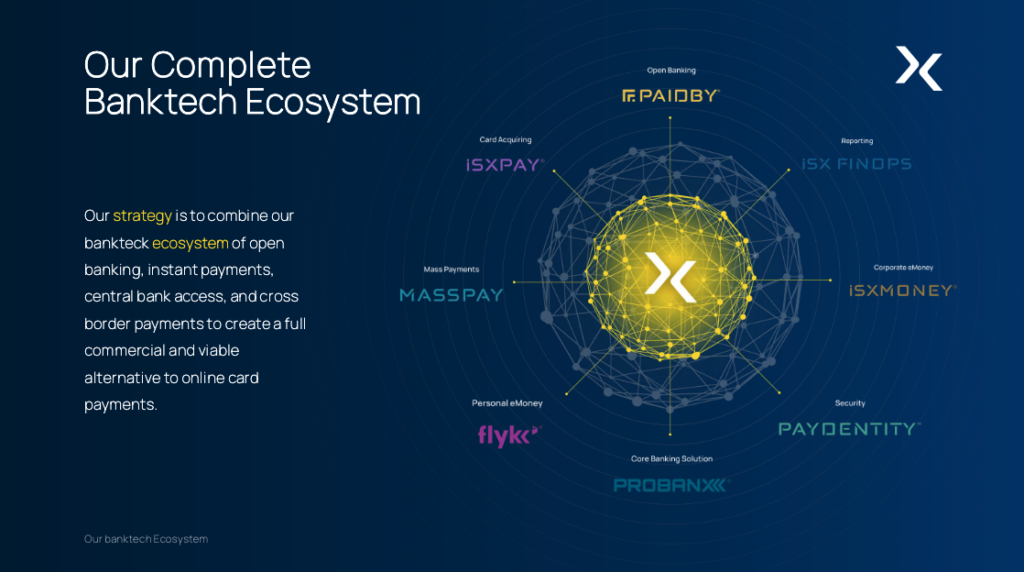
Probanx and flykk serve different audiences: other EMIs and consumers, respectively. Separate branding there makes sense. But the rest all target the same merchant. PaidBy, MassPay, ISXMoney, ISXPay, Paydentity: five brand names competing for the same prospect’s attention, each telling a fragment of a story that only works when told whole.
ISX’s biggest differentiator is depth of integration. Network, business, transaction. Everything connected on one backbone. So why brand payouts as a standalone product? Why give KYC its own identity? Why split accounts and payments into separate names? The brand architecture contradicts the very promise ISX should be making.
There is no single narrative. No positioning ISX owns. No emotional hook that makes prospects pay attention, let alone choose ISX for what it actually is: a financial stack that goes deep to offer certainty.
And the window won’t stay open forever. The T2 access advantage will narrow as more EMIs connect. The in-house technology edge will erode as AI makes it easier to build. What competitors can’t easily replicate is a brand position that’s already lodged in prospects’ minds. ISX has the structural lead today. Without a story that travels, they’re leaving it to competitors to claim the position first.
ISX is winning despite its story, not because of it. With €58.7 million in revenue, €26 million in net profit, and many of the industry’s top operators as clients, the competitive edge clearly works. But that success comes from getting in the room and explaining face to face. The story doesn’t travel on its own. Imagine what ISX could do if prospects understood the value before the first meeting.
ISX’s depth is real. Deep into the network, deep into the business, deep into the transaction. Each layer delivers certainty that no other EMI in this space can match.
But depth alone doesn’t win deals. Operators don’t want to understand T2 connections or core banking architecture. It needs to be translated into a story that moves prospects to action. Right now, ISX sounds like everyone else: “trust us”. And in a market where every EMI shouts the same thing, that message drowns in the noise.
Businesses want a financial stack they can lean on. That’s the feeling ISX’s depth creates, but it’s not the story they tell.
When it comes down to its brand narrative, ISX is lost in translation.
HaArba'a St 28, Tel Aviv-Yafo
© Copyright 2025 by Braintail